

Sarah M. Dunifon

Three children water plants next to a playground
As readers may already know from past pieces on A Fictional Future Fest and Storytelling, I enjoy futurecasting, or the act of imagining and preparing for the future. A part of my approach to this strategy is staying up-to-date with conversations in adjacent fields, like science communication, publishing, journalism, science policy, and AI and machine learning. Another part is regularly running exercises to forecast what informal STEM learning (or evaluation, or museums and institutions, etc.) will look like five, ten, or even twenty years from now.
A resource I find particularly useful for this work is the human-centered design firm, IDEO. I recommend subscribing to their newsletter for regular updates on what they’re thinking about (spoiler: a lot of AI integration for business, futurecasting, and other strategy work tied to the monumental technological upheaval we’re in the midst of). Recently, they sent out this exercise that I found helpful and wanted to share.
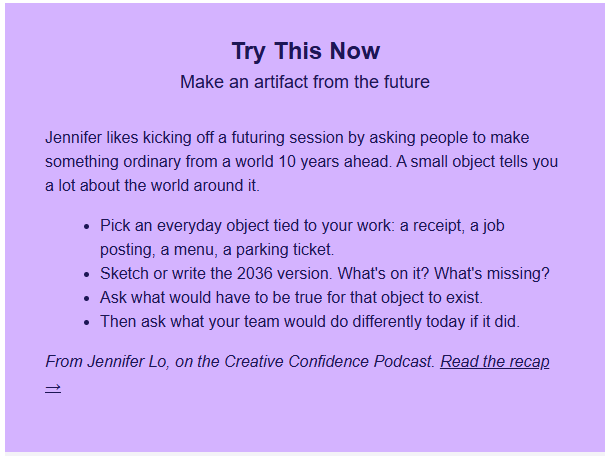
An exercise in future thinking from IDEO
As seen above, the prompt asks you first to pick an object tied to your work. For this exercise, I chose Dedoose, a qualitative analysis software tool that helps our team at Improved Insights to organize qualitative data, apply codes, identify themes and outliers, and run other analyses.
Second, you’re asked to imagine a 2036 version of this item. The prompt asks you to consider “What’s on it?” and “What’s missing?” For my example, I wrote that a 2036 version might have AI-enabled functionality that allows for immediate qualitative analysis according to the inputs specified by the user (e.g., evaluation questions, information on program context, notes about responses, etc.). Now, this prompt asks you to imagine what is likely, not necessarily what you’d like to see. In my case, it’s likely that AI-functionality will be more prevalent in research and evaluation software in the coming years, though many folks are leery about its adoption. A primary area of concern at the moment is the potential for AI trained on publicly available datasets to mirror the biases in those datasets in its interpretation of new data (for a more in-depth explanation of this issue, check out this resource from UC Berkeley). In 2036, I’d imagine researchers will have figured out how to address these issues, making it more ethically and equitably suited for the work. The next part of the prompt asks, “What is missing?” For my example, I wrote that perhaps some element of “what to do with the data now” is missing; one that explores how the results of an analysis can be used for program improvement, or how to identify what is most important to communicate to supporters. Another concern about using AI in social science research and evaluation is that AI won’t necessarily make decisions in the same way that humans do. Some even argue that AI should never make decisions as “A computer can never be held accountable, therefore a computer must never make a management decision” (IBM Training Manual, 1979). So, something that seems necessary still is some sort of human element that uses AI as a tool to support human-made decision-making, not replace it.
The third step of the prompt asks, “What would have to be true for this object to exist today?” Now personally, I didn’t write much here as I largely explained my thinking on step 2, but to summarize: AI-enabled functionality that (1) is not influenced by inherent biases, and (2) allows for human decision-making. For this to be true today, we likely would have to be much more focused on the ethical rollout of AI, instead of the current race to the top. More regulation and thoughtful input from AI and technology ethicists would need to be adopted to guide the creation and adoption of AI tools.
Finally, the prompt asks, “What would your team do differently if it were available today?” If it were available today, and certainly, multiple versions of AI-enabled qualitative analysis platforms are already available, it’s just the question of “how good are they?” from the lens of not only their ability to complete tasks, but also concerns about how the models were trained, whether they can recognize different theoretical approaches to analysis, etc. In other spaces where concern for ethical implementation is not considered as fully, say in analyzing marketing data, AI tools are already adopted. But if the 2036 version of the software I spoke of were already available today (and it’s likely to be here even sooner than that) I’d say that our team would focus a lot more on values, strategy, decision-making, incorporating findings, and the other non-static, creative human elements of the process, and less on the data analysis, instrument design, and other parts of the evaluation process more well-suited for AI support.
For your purposes, you might adapt this exercise to think about an item that you regularly use in your workspace. My example was very AI-focused, but yours might be on something completely different. Think broadly with this exercise. You can focus on software, physical items, mediums through which you collect or distribute information, etc. Ideally, choose something that you use a lot and is integral to your work. A few ideas are below.
A museum director might consider a physical artifact in their collections.
A zoo educator might think about the biofacts they use with student groups.
An evaluation director might consider a slide deck as a presentation tool.
A learning ecosystem manager might think about materials used in annual strategic planning
You might find this exercise not only helps you imagine and plan for the future, but make sense of the present and even notice a blind spot or two that you can address now. I hope this exercise was helpful to you as it was to me.
We hope you enjoyed this article! If you’d like to see more content like this as it comes out, subscribe to our newsletter Insights & Opportunities. Subscribers get direct access to our blog posts, as well as recent news and resources, funding, jobs, and professional development opportunities from the informal STEM learning community. Join us!