

Informal Learning, Civic Virtue, and Identity Development (Part 2)
An interview with Dr. Erhardt Graeff
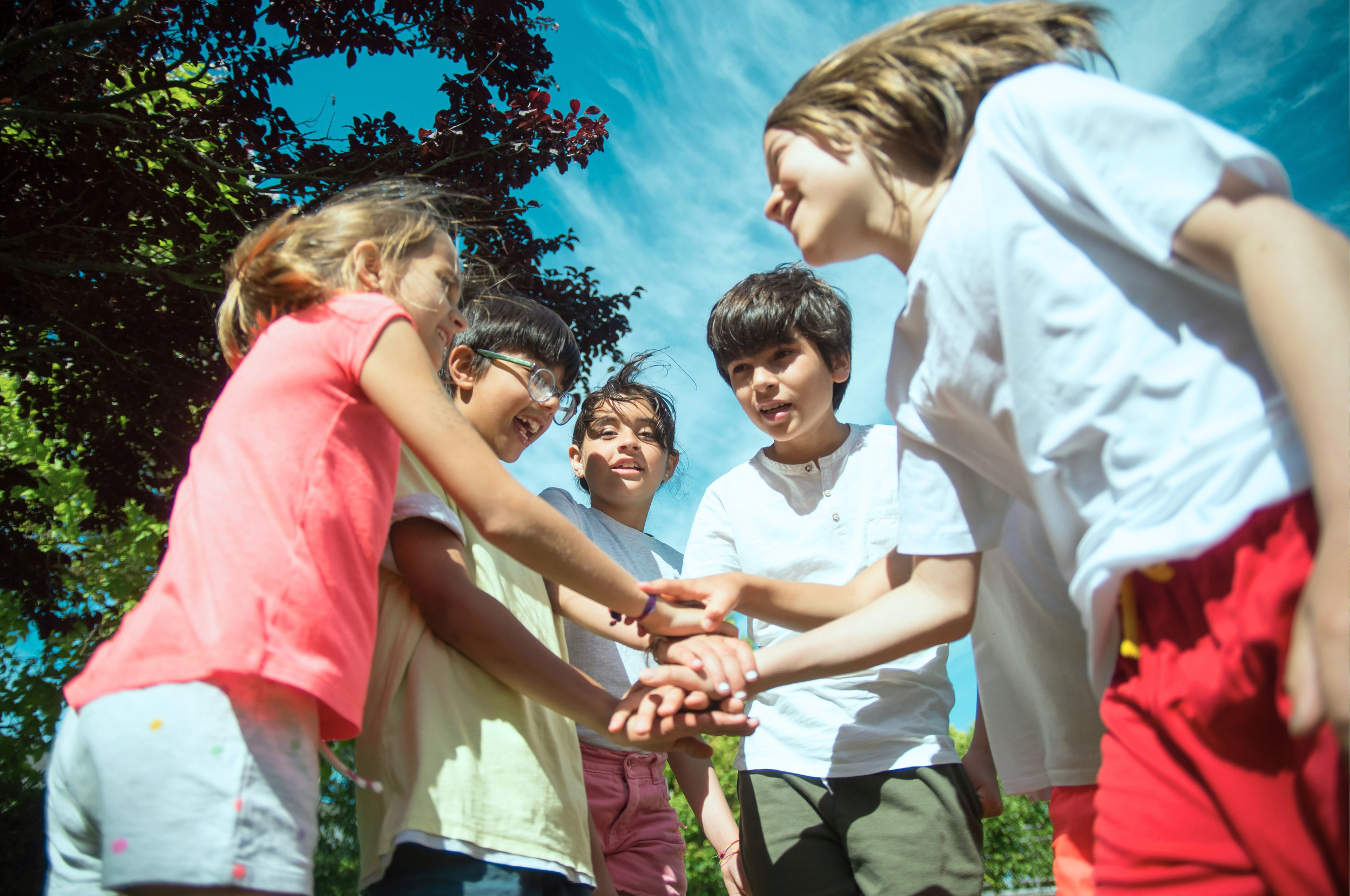
A group of children stack hands while playing in a park
Welcome back to part two of my interview with Dr. Erhardt Graeff, a social scientist, public interest technologist, public official, and Professor of Social and Computer Science at Olin College whose work spans two areas: the design and use of technology for civic engagement, civic learning, and social justice; and the ethical responsibility of technologists as stewards of democracy.
In part two of the series, we dive deeper into identity development and practices for informal educators. We review:
when and where identity development is occurring in young people
why engineering is a great occupation for people who care about relationships, community, and context
why designing for transformational experiences and “strangeness” are good strategies to build personal, professional, and civic identities
how informal educators are uniquely positioned to assist students with civic identity development
practices informal educators can adopt in their learning contexts to promote civic-mindedness
Let’s get started!
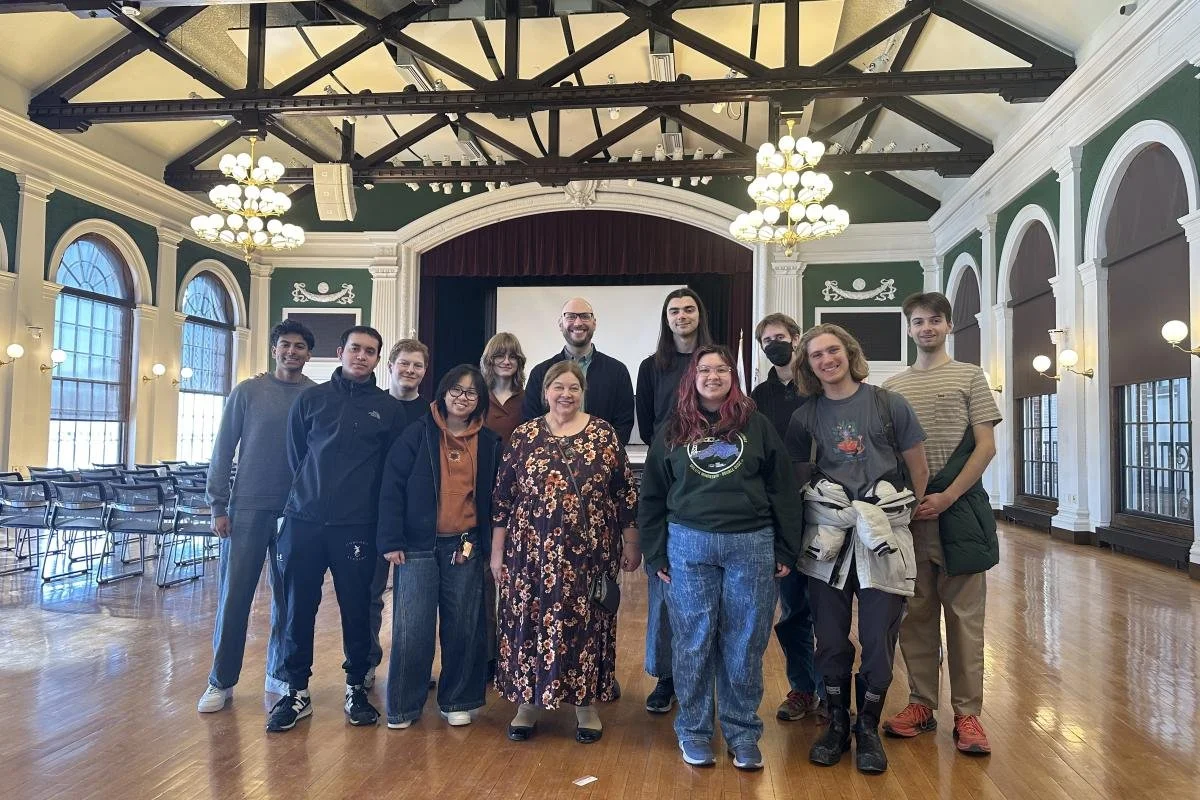
Professor Graeff’s Local Democracy students pose for a group photo inside Needham Town Hall.
Dr. Sarah Dunifon: Let’s talk more about identity development. Alignment with these virtues could be considered identity development, and many researchers cite middle school as the time when students develop a STEM identity and determine if they wish to continue to pursue STEM. So, is there strategic potential, from your perspective, in incorporating civic virtue into middle school level engineering education, either in formal or informal settings?
Dr. Erhardt Graeff: So, I don’t know, and I don’t want to over-claim things. I don’t know how moral development aligns with some of these STEM identity development questions. But what I do believe is that one of the things that undergraduate education has abandoned in recent decades is this idea that we are responsible for the moral and character formation of our students. Instead, it’s more and more purely vocational development. And by not acknowledging that responsibility [to help develop character], we are doing a disservice to students’ holistic identity development.
We should be creating spaces where they’re reflecting on themselves as whole people; the professional, civic, and personal identities that are being developed during those four years across all these different contexts inside and outside of the classroom.
My impression is that at the high school and middle school level, there’s also been a retreat away from some of those questions of identity and character formation.
Whether or not there are important seeds of identity and moral formation that are missing in those middle school years or not might be debatable. But I can tell you that character and identity formation is all about practice. It’s all about the things you’re exposed to, and all of those things matter. So, if we aren’t being intentional about the fact that we are sending messages to our students about those things, then we’re missing an opportunity to support our students, and possibly creating a vacuum that’s just going to be filled with more messages from other sources, from the media, from whoever’s peddling their particular view of what education is, which is more and more about those pre-vocational opportunities.
I would want us to think [about civic virtue development] at the middle school level the same way we’re trying to be intentional about ensuring that students don’t step away from a STEM identity. Once again, I think we can do that through the types of experiences that students have. These rich experiences that are real-world. I think some of the most interesting things that have happened in STEM education, especially informal science education, for middle school and high school students, have been around citizen science. How do you get students involved in actually doing scientific work that’s keeping track of water and air quality measures in their local community and contributing to data sets? For example, here in the Boston area, the Charles River Watershed Association is really good about involving citizens and laypeople in their work. Different ways that students feel like they’re connecting technical work with that sense of, “Oh, this is a way that I can serve the world or conserve the public good,” I think are really valuable.
I think when we look at admissions essays here at Olin, a lot of students are asked either explicitly in prompts, or they choose to talk about why they think engineering is a calling for them as a way to serve the world. To make the world a better place. And I think that’s always key to how we have an inclusive STEM identity proposition.
But it’s also explicitly in terms of virtue and character, and who you want to be. What’s your identity as an engineer? It’s not just, “I’m solving these problems, and I like math, I like the black and white.” There are lots of students that go into engineering because they want discrete answers. They don’t want the messiness. And the more we’re challenging that notion, that actually, engineers step into that messiness – and yeah, maybe they’re simplifying things through models that are making assumptions that are useful to solving complex problems – but then bringing it back to the complexity as they test those assumptions and those models as they’re trying to implement solutions. Being realistic about the context of what it means to do that work unites these pieces around identity and character.
Dunifon: I’m wondering if embedding some of these virtues into engineering education might actually make engineering a more desirable prospect for women and girls. There is some research to show that women and girls are socialized in this culture of care: to care about other people, to work towards a greater purpose, perhaps even more civic-mindedness. And I think that part of the difficulty recruiting women and girls into engineering is that it can be perceived as cold or objective, and it doesn’t really have a place in this overall culture of care that we’re taught to ascribe to.
So, I’m wondering, do you think that there’s any potential benefit in marrying these two different spaces together, or making it more apparent that they do work together, instead of avoiding that topic? Do you think that could work to increase more diverse representation in engineering?
Graeff: I think so, and I think Olin College has been on the vanguard of that since its inception. We’ve always been aware of this idea that it makes a difference when you talk about the ways engineering is situated within particular contexts and is relational. We’ve long taken a project-based learning approach to connect to real-world context and problem space, and we can imagine, if not work with, real people in a relational way.
That’s definitely what’s inspired me, in part, to say that we need a new response to “How do we teach ethics in engineering?” And “How do we increase civic-mindedness in engineering?” It’s all about context, it’s all about relationality.
Framing matters. We have data that show when women go into engineering, they often gravitate toward disciplines and applications that are more obviously contextually related and relational—like biomedical engineering, where that kind of care type of relationship is very explicit. The sense that I’m doing this to help this person. It’s not abstract. It’s something that draws people in.
I want to be clear: the opportunity here isn’t to steer more women toward the “caring” corners of engineering. Instead, we can make the relational, contextual nature of all engineering more explicit, because that’s a truer picture of the work anyway. When we do that, we make engineering resonant for a much wider range of people, and we do it without asking folks to check their values at the door.
Dunifon: Readers of the newsletter and my blog are largely in the informal learning space. I’m wondering what lessons could be taken from your work that could be applied to learners of different ages – maybe middle school, high school, maybe even older – or in different learning contexts, like informal learning or afterschool?
Graeff: The thrust of my work, which started with civic-mindedness, is now more and more about these questions of virtue and character formation, and the ways that those things (your personal, professional, and civic identity developments) are a product of transformational experiences. I would say that it’s really hard to transform someone within the four walls of a classroom.
Carolin Kreber borrows this idea from another philosopher, Ronald Barnett, of strangeness. That we try to find strangeness in educational experiences, because it’s this tension of our preconceived notions of the world, and something that challenges those. And when there’s a gap, it forces us to be uncomfortable, and to either resist that [discomfort] or be transformed by it in some way.
If informal educators are thinking about how they design their experiences, the first thing they should figure out is, “How might I design for transformation?” To give students that feeling of tension, that feeling of strangeness.
Other things that they can do is say, “What can I learn about character formation, from the ways that students develop their personal and professional identity?” Some of the best ways that we know those things happen are through modeling.
If you’re an educator, you are inherently a mentor. Folks that are STEM educators are often modeling curiosity. Stepping into that and saying, “I’m actually going to play that up and show my curiosity about this thing, and explain why that draws my curiosity, why that’s so interesting,” often that can be infectious for students.
So how do you model those other virtues of care or courage in the ways that you show up in those spaces? Or civility? Like, I’m going to share my power in this moment right now and say, I am giving as much time to somebody who’s in the community that’s on-site in this place. Or I’m giving that power to the student who’s showing up in that space and having them be the teacher and explain to other folks. And I’m learning from them, I’m modeling my willingness to learn from them, and the expertise that student has. That’s a way of showcasing humility in education that I think is really powerful. Leaning into those things, leaning into those types of experiences, and experiential education I think is really powerful.
I love museums that are situated with the history of why this thing in this place. And making that come alive for a student is really hard, but worthwhile. It’s not necessarily the most important thing that a student takes away this particular mechanical concept from this lesson, but that they take away that they are someone who can learn these things and is interested in these things. Or that allows them to be courageous in that moment.
Something that scares them, intimidates them about that concept or that context, and they had that opportunity to practice that courage in that moment, that’s probably way more important than whatever was the scientific concept that you hoped that they would take away.
Dunifon: There were a few things from your responses that I think could be lessons for the informal learning community, if they’re thinking about applying responsible community engagement in their work, maybe in an after-school, out-of-school, summer camp, some sort of other context.
You talked about building social and relational skills, bringing in guest speakers to speak about their own experiences, educators showing up in authentic ways, place-based learning and field trips, and then applied and experiential projects being good avenues.
Are there any other lessons or things that you think folks in informal learning settings could take away from that concept of responsible community engagement and building that as a way of thinking and a practice for students in these informal contexts?
Graeff: It’s hard to say what I can add to that, because I feel like there are so many folks in the informal education space that are actually experts, and have in many ways pioneered those approaches in ways that traditional undergraduate educators have had to learn and incorporate into the ways that we do things.
The thing that might not be obvious, and that I’ll just return to in response to your question, is this idea of character identity formation as being something that is happening all the time, whether or not you are designing for that or intending it to happen. I have to thank the folks at the Educating Character Initiative, a project of the Program for Leadership and Character at Wake Forest University, which has been funding me to think more and more about virtue, ethics, and character in undergraduate engineering. They really pushed me to remember that character is a practice that happens within a community context. It’s how you show up in every interaction. Your day is filled with opportunities for moral action.
You should realize as educators in those informal settings that this is happening in whatever you’re doing. Students are having this opportunity to explore questions of moral action. How do they work together with their peers in those spaces? How are they talking to you as the educator? How are they engaging with communities that might be the places in which you’re doing that work? And if you’re not aware about that, then maybe you aren’t aware of the opportunity you have to help students show up in those places that form their character in really positive ways.
Let’s not forget that in all of those moments we are modeling something about what it means to be virtuous whenever we’re showing up with people. Our middle school students, our high school students, are our most impressionable. When it comes to the signals that they’re getting about what matters and how we define what is good.
One other thing that is really important to how I understand civic virtue, and this idea of civic-mindedness in professional work, is that it’s about community. It’s about the common good. How do you serve the public interest? And centering that in your work, and how you approach different problems and questions.
I think it’s very easy to default to an individual approach to education and to problem solving. If you can resist that a little bit, and say, no, we’re actually collaborating with each other on this, there are positive opportunities in social learning. And engaged projects and experiential learning should contend with the question of how this is not just serving the learners.
Dunifon: If folks are interested in learning more about this work, what resources would you refer them to?
Graeff: I’m an academic, so some things that are interesting philosophical pieces that have been inspirational to me come from other academics like Shannon Vallor. Her book on Technology and the Virtues is really what kind of helped me think differently about virtue ethics and the way it applies to the STEM space. She has a newer book, called The AI Mirror, which is specifically taking some of these ideas and applying them to the problem presented by AI and LLMs.
Carolin Kreber’s book I’ve already mentioned, Educating for Civic-mindedness, is really inspirational to me. It’s a dense piece of philosophy, but the core ideas, I think, are really powerful.
There are other things that I point to in my teaching that have been inspirational to me, that respond to this idea of the culture of disengagement, by Erin Cech. She has a peer-reviewed paper on this concept, but she’s coming from a tradition of science and technology studies that looks at systems and problems as not purely technical, but as socio-technical systems and problems.
Key ideas in essays like, Do Artifacts Have Politics? by Langdon Winner, which challenges this idea that the built world, that technology is somehow just tacit, and not having some sort of impact on our social and political systems, I think is really a powerful thing.
Another space that I’ve been participating in for many years now is the Public Interest Technology University Network, which Olin is a member of. It is trying to push a definition of technology professional that sees their responsibility to the public interest, and really brings together different fields to say that there are folks in public policy, in political science, or social work, or communications that also are technologists. It’s not just computer science, computer scientists. It’s not just engineers. And that folks need to learn something about these different spaces. They need to understand these skills and perspectives that come from different domains in order to ensure that they are designing and using technology that serves the public interest. Looking at that website and some of the publications and definitions, and the ways that they’re trying to emphasize that, I think is a great resource.
Dunifon: What other work in STEM learning or similar spaces is catching your interest these days?
Graeff: I’m paying a lot of attention to AI right now. And I started specifically thinking and writing about AI and virtue, and the way it challenges virtue and character formation in ways that might not be obvious. Shannon Vallor has written a little bit about this in her book, The AI Mirror. But I’m somebody who teaches design, and there are some specific challenges to designers if they become reliant on LLMs, chatbots, for guiding their design work.
There’s one explicit challenge to humility that I’ve been focused a lot on, which is that designers try to show up with humility into these spaces, so that they can understand folks that are living the challenges that they’re trying to design solutions for. We have these ideas, like human-centered design and collaborative design, that try to create some processes in which we work with those folks, to define problems in their terms, etc. And I think what’s interesting or what’s challenging about AI is there’s already pressure within industry to try and shortcut some of that work of going to real people and asking them their opinions and working with them to do that design work. Like, what if we just typed it into the chatbot and tried to see what it thinks is important based on everything that it has read on the internet about this problem? You get a false sense of confidence when you do that. You could use that as an input into a process in which you’re then talking to folks and saying, what have I missed that might be an important question to ask? But if you are being pressed to skip some of those processes and use the synthesized user, where you ask the LLM to imagine a user, as opposed to actually having humans in this moment, that’s really dangerous. We know that there are biases in the ways that these things work and what’s missing in their training data.
There’s also the humility that is on the opposite side of this, the other form of vice in humility, which is being overly humble or not trusting yourself. I see this happen with my students. They go through an intense experience of learning human-centered design, in which they learn a process that necessarily has to be informed by the stakeholders, people that are directly affected by these things, and then they get to a point where they get stuck. They don’t trust their own design instincts or their own responsibility as the designer to shape that process, to facilitate that. And they’re waiting on these folks that are not necessarily in the best position to make decisions about design work. People that they see as the most directly affected by this thing, but are not necessarily designers, and shouldn’t be given or forced to have this responsibility of sorting out what to do next in the design process. So, they advocate for that responsibility. They’re overly humble.
We see the same thing in some early research on the ways students are being sensitized through their AI use. They’re not trusting themselves to answer questions. They’re constantly going back for the most mundane things, whether it’s arithmetic, or how do I respond to this text message from a friend or a teammate. And when they lose that trust in themselves, they’re going to be losing what are the key components of forging professional identity and what their responsibilities are to be a designer who’s guiding a design process. They’re not going to be able, when they’re working with a client or a community partner, to be constantly referencing a chatbot about what they should do next, about how they should respond in that moment. And this is once again why I love experiential learning and forcing students into these uncomfortable situations that stretch them. But I worry that when they take all these mundane tasks into AI that they are going to be ill-prepared to step into those experiences. I want them to develop that appropriate level of confidence. I want them to feel like I am the person who guides this, that I have this. It’s the same reason why we want to make sure folks feel like they can go into STEM. It’s because they can do that work, it’s not beyond them. So, that’s something I’m really paying attention to.
To learn more about Dr. Graeff and his work, visit https://erhardtgraeff.com/. For more on Dr. Graeff’s newly funded project with the Educating Character Initiative, visit this announcement page.
References:
Barnett, R. (2005). Recapturing the Universal in the University. Educational Philosophy and Theory, 37(6), 785–797. https://doi.org/10.1111/j.1469-5812.2005.00158.x
We hope you enjoyed this article! If you’d like to see more content like this as it comes out, subscribe to our newsletter Insights & Opportunities. Subscribers get first access to our blog posts, as well as Improved Insights updates and our 60-Second Suggestions. Join us!