

Dr. Sarah Dunifon
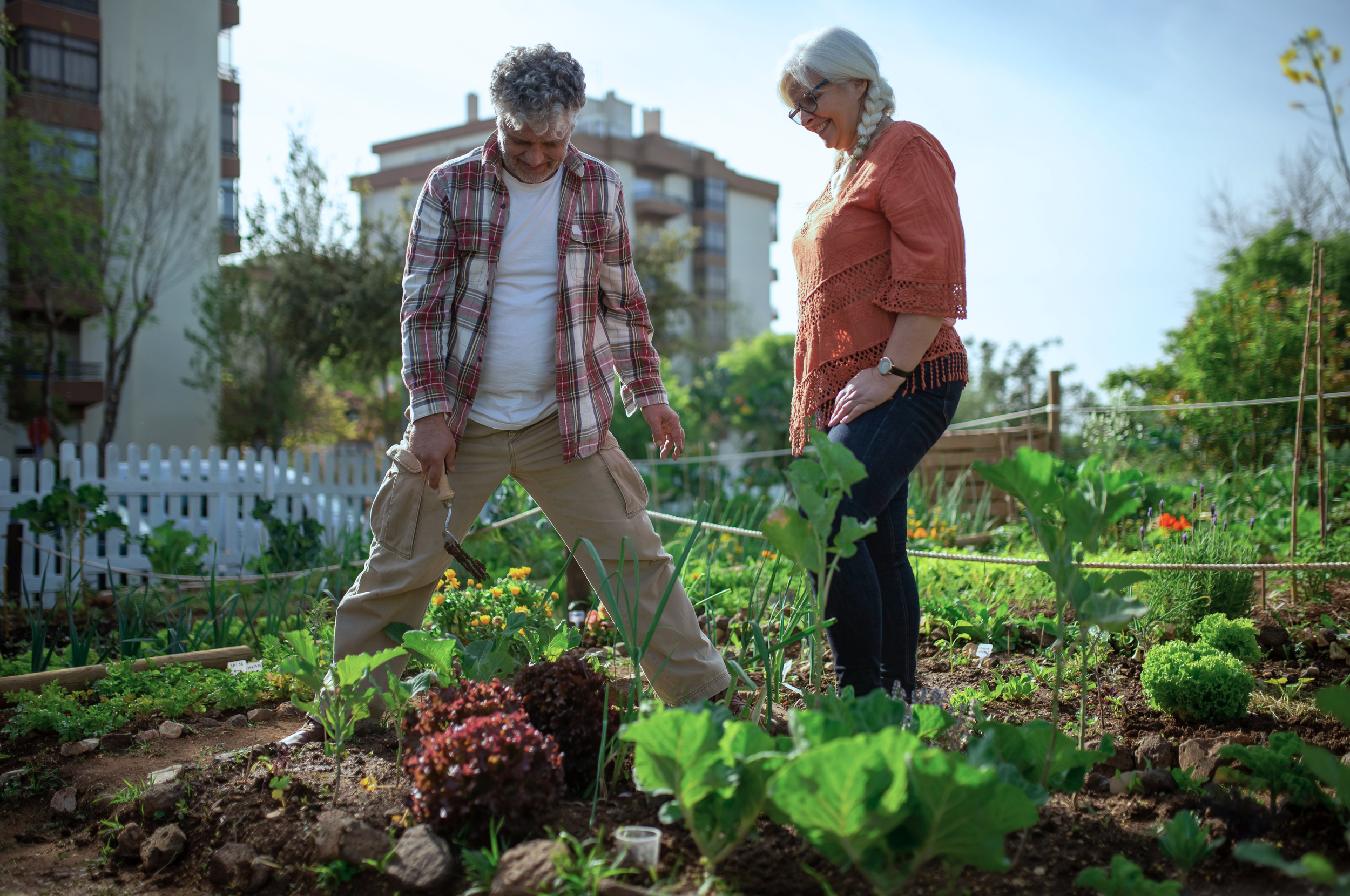
Two gardeners stand over a bed of lettuce in a community garden.
What is Regeneration?
Regeneration can be defined in many ways, depending on the discipline in which it is used, but typically means to restore, renew, or improve. In the medical field, the term is commonly used to define the process by which cells are repaired or regrown. In urban planning and policy, it can describe a city’s revitalization by way of new industry or increased population. In ecological sciences, it often refers to practices like regenerative agriculture, which works to restore biodiversity and nutrient diversity in depleted soil.
For the purpose of this piece, I define regeneration as a mechanism for evaluation to restore and improve its systems and its impact on communities. In my initial writing of this piece, I was unaware of any work yet done to connect regeneration as a concept to evaluation and learning. Therefore, I will not be citing any other works that informed my thinking. However, it is important to recognize that others have had these same ideas, and work is starting to emerge on this concept from other practitioners and researchers. I expect to see much more development of these ideas as the field considers this approach. I will also shy away from using the term “regenerative evaluation” as this has already been used in other contexts. To learn more about it, I highly recommend looking into the work of Jannik Kaiser.
I started musing on the concept of “regeneration” while out on a walk. As someone interested in regenerative agriculture approaches, soil health, agroecological practices, and other approaches to making our food and agricultural systems more climate-friendly, I started to think about how to apply similar principles to evaluation and learning as disciplines. After organizing my thoughts later in the day, I landed on several core concepts to discuss:
Evaluation as a Cycle
Learning and Application as Integral
Generation of Restorative Knowledge
Evaluation as Relational
Recognizing History and Context
Evaluation as a Cycle
One of the most important things to understand about evaluation is that it’s not a “one-and-done” situation, but a cyclical process that leads to learning and growth. In fact, the evaluation cycle is widely spoken about in many different areas. In a program evaluation, this cycle typically includes steps like:
Investigating the needs and context
Developing an evaluation approach and tools to collect data
Collecting data
Analyzing data
Interpreting and reporting on findings
Assessing findings and recommendations
Implementing changes to the program
You might be familiar with these steps as a linear process, from start to finish. But it’s important to remember that implementing evaluation well within an organization necessitates that we look at this system as a cycle. Cycles may be tied to calendar years or school years, but they can also be tied to shorter timeframes. In a regenerative approach, rapid learning cycles could be employed, allowing us to make sense of things happening in real time and make adjustments as needed.
Learning and Application as Integral
Viewing evaluation as a cycle allows us to continuously learn and engage with what is happening in the program now, and not only when tied to a grant or other external pressure. Much like the evaluation cycle, supporting continuous learning is integral to doing this work well.
It's also important to recognize that programs change over time, even if the curriculum stays the same. Different staff, audiences, outside contexts, changes in the science, and other factors can influence how a program is received. Therefore, viewing evaluation and learning in a cyclical way ensures you stay on top of what is happening at your institution or in your programs.
The application of learning from evaluation is often taken as actions that change program elements or content. This might mean recentering core concepts that participants aren’t fully grasping, or perhaps retooling a program to better suit a target age level. Without the application of learning, the work is incomplete. A regenerative approach would emphasize the evaluation and learning cycles and build a model in which evaluation, learning, and action all feed into each other.
Generation of Restorative Knowledge
Evaluation can generate new knowledge that supports things like program improvement, capturing impact, or deepening our understanding of concepts and audiences more broadly. In the existing systems, this knowledge is typically extracted from our audiences and communicated to our practitioner or academic peers through articles, evaluation reports, and conference presentations. It can also generate new questions, which in turn create new knowledge, and the cycle goes on.
A regenerative approach to this idea would focus on how to turn an extractive practice into one that feeds knowledge back into communities. This might include making findings more widely available and sharing results accessibly with our communities. In this case, we might move away from long, gatekept reports to more accessible formats like social media posts, signs within our institutions, or short reader-friendly digests. Our communities could also be included in more stages of the evaluation process, like planning and interpretation. Now, these are not totally new concepts - many evaluation approaches already emphasize power sharing and participatory methods like these - but through the lens of regenerative thinking, which focuses on returning benefits to the system, we want to think about ways that communities and/or our audiences can learn from, benefit from, and grow as a result of engaging with these processes.
A more systems-oriented approach to this idea would be to consider how knowledge generation resulting from evaluation could fit into the overarching funding cycle. Currently, funding, programs, and evaluation are intrinsically linked within our system, all centered around impacting communities (Figure 1).
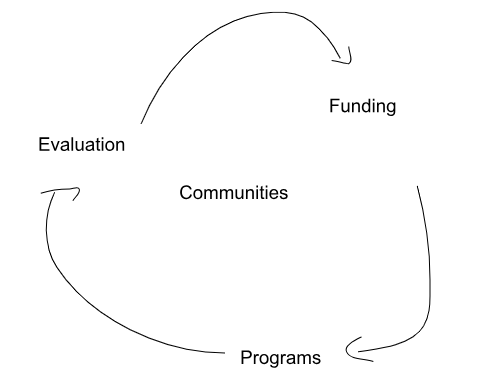
Figure 1. Nonprofit Mechanism
A next consideration would be to emphasize learning and knowledge generation in this process, and how the inclusion of these pieces would actually work to restore or improve existing models.
Evaluation as Relational
Having served as an internal evaluator (i.e., working within a single institution) and an external evaluator (i.e., consulting with many organizations), the idea of evaluation as a relational process is one that I feel is very important and incredibly overlooked. When I was an internal evaluator, I had the chance to build relationships with the staff at the institution I worked with, as well as with program participants. As a consultant, I’m often hired for short-term projects that make it difficult to develop relationships. However, several of my clients have turned into “repeat business,” and I’ve been able to develop deeper relationships and institutional knowledge as a result.
But why is this important? For many reasons, including (1) developing a deeper and more accurate understanding of an organization, its programs, its audiences, and the context in which it operates; (2) developing trust between the different parties engaged in an evaluation (i.e., staff, participants, the evaluator); and (3) building systems and deliverables that better suit the needs of the organization. Now, these are all tactical reasons for viewing evaluation as a relational process, but looking at the concept through the lens of regenerative practices, we might also add that fostering ongoing relationships between evaluators and organizations, or between organizations and community, and not just offering one-off amendments (to borrow a regenerative agricultural term) or evaluations (to be more specific to this context), will lead to better connection, reciprocity, and overall success.
Recognizing History and Context
As has long been an important part of evaluation work, understanding the history and context of a program and its communities is integral to equitable, culturally responsive, and other inclusive approaches. Regenerative thinking in this area may include investing in building learning in place, not extracting knowledge for outside appreciation. In existing practice, this often looks like writing heady evaluation reports or academic articles and either distributing them to funders or publishing in journals. It might also mean presenting findings at a conference or professional meeting. These methods, while definitely important in growing a body of knowledge for other practitioners (or for “proving” success to funders), can lean towards the extractive. Communities have little avenue to engage with the new knowledge that they helped to create, if it is distributed to them at all.
So, what would a regenerative approach look like? There are many possible approaches, but here are a few examples that came to mind:
Building learning in place (i.e., hosting data walks and meaning-making sessions that include participants and community members)
Reinvesting the learning locally (i.e., sharing results with other nonprofits in your space or geography)
Building local learning communities (i.e., establishing groups of practitioners and maybe participants or community members as well, to discuss the results of other evaluation efforts at similar institutions, at your organization, or surrounding topics you care about)
Through the lens of regeneration, this may also include a principle we can borrow from the ecological space: “working with the elements and not against them.” In agriculture, this might mean shifting your crop plan to plants that will do better in the specific type of soil you have. In evaluation and learning, we can think of it as focusing on the assets and strengths of a program in place of deficits. Those from an education background know that deficit thinking points out the negatives (or imagined negatives) and seeks to remedy them (e.g., using the term “at-risk youth” to describe a population). A strengths-based or growth approach is the opposite, and seeks to elevate the existing positives, hoping to grow them into greater success.
In our evaluation work, we might consider the framework or approach we take as well as the systems we use to conduct the work. We might also consider the unique benefits we have at this point in time and how we can capitalize on them to build. For example (and to mix metaphors), while the funding space may feel like a “drought” at the current moment for many nonprofits, leading to fewer “crops thriving,” could it also offer an opportunity to build our systems from the ground up? Could we, as a system of nonprofits, funders, communities, and evaluators, decide that this is the time we renew our practices?
-
These musings seek to serve as an opportunity for reflection and imagining. They certainly do not cover all the core tenets of how evaluation and learning can aim to be more regenerative, and I’m sure I left out important pieces. However, the exercise was helpful for me to think about how we can apply more relational, contextual, and cyclical approaches to evaluation to allow for more restoration and improvement of the spaces we inhabit. Perhaps there are pieces of this thinking that resonate with you and that you might apply to your own thinking about the topic. Thanks for reading!
We hope you enjoyed this article! If you’d like to see more content like this as it comes out, subscribe to our newsletter Insights & Opportunities. Subscribers get first access to our blog posts, as well as Improved Insights updates and our 60-Second Suggestions. Join us!