

Civic Virtue in Undergraduate Engineering Education (Part 1)
An interview with Dr. Erhardt Graeff
Three college students study while sitting on the university steps.
I’m always interested in new ideas, unique intersections between fields, and translating insights from other fields into the space of informal learning. This week, I sat down with Dr. Erhardt Graeff, a social scientist, public interest technologist, public official, and Professor of Social and Computer Science at Olin College whose work spans two areas: the design and use of technology for civic engagement, civic learning, and social justice; and the ethical responsibility of technologists as stewards of democracy.
In part one of a two part series, we discuss Dr. Graeff’s approach to civic virtue and its role in undergraduate engineering education. We cover:
what civic virtue is and how it can be incorporated into engineering education,
the “culture of disengagement” in engineering education,
the four technomoral values (i.e., care, courage, humility, and civility) that can be fostered in experiential learning experiences,
how storytelling can help us understand civic virtue development, and
lessons on practicing responsible community engagement in experiential learning.
Informal learning practitioners can use this interview to develop their understanding of these concepts and how they operate in formal learning environments. In part two, we’ll dive into what practices informal learning institutions can adopt from Dr. Graeff’s work to steward the next generation of engineers.
Let’s get started!
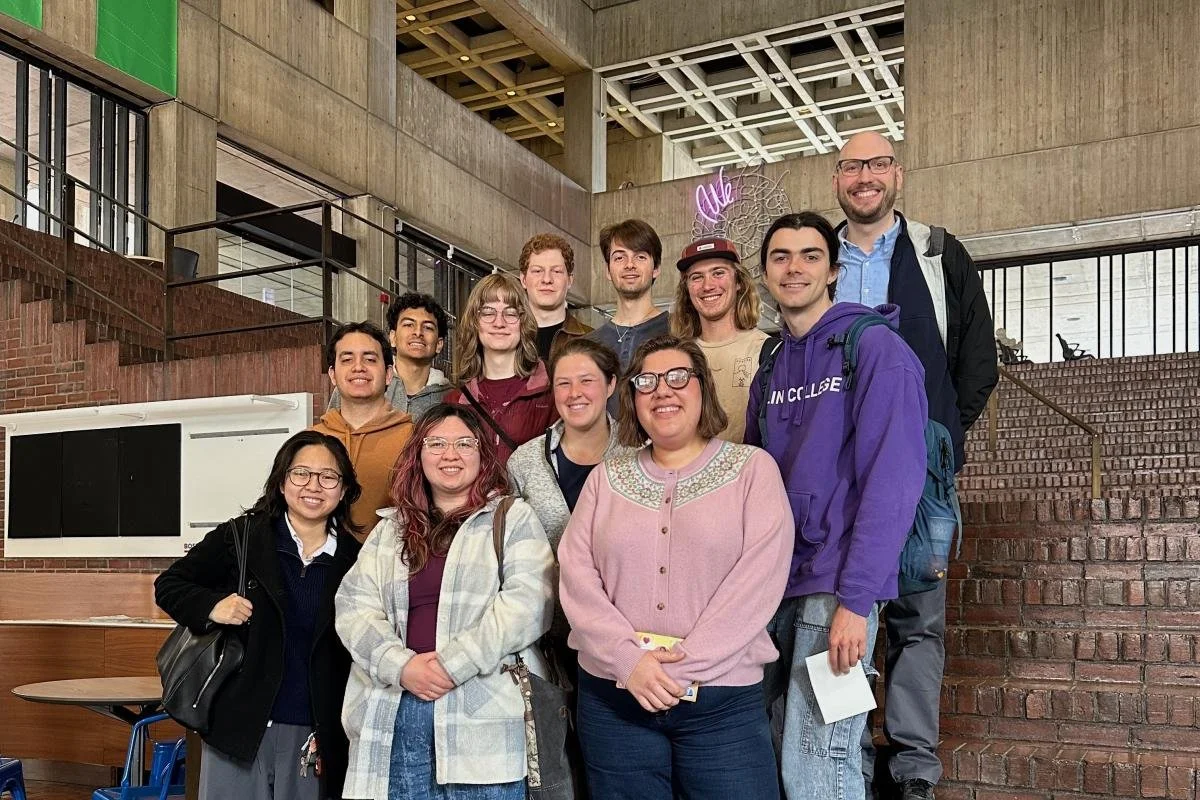
Professor Graeff’s Local Democracy class stand on the steps outside Boston City Hall.
Dr. Sarah Dunifon: Can you describe your work incorporating civic virtue into undergraduate engineering education?
Dr. Erhardt Graeff: I believe that engineers have both implicit and explicit civic responsibilities. And that has arisen from my work looking at questions at the intersection of technology, civic engagement, and politics for many years.
I was a researcher in graduate school, but also worked at Facebook on their civic engagement team as an intern, and really saw how those things came together: what the goals were of folks, what were the ways that they were bringing that to bear as a practice in their design work.
I resolved that if I was going to go into teaching, that my responsibility would be to help students really think about the intersection of these identities, their kind of professional identity as engineers, their personal identity as good people, and their civic identity as citizens, folks that are responsible to the common good.
So when I think about that in terms of undergraduate education, to me, that means anytime I'm teaching, I'm trying to be a mentor that's integrating those things in the ways I talk about our professional identity development. I'd say that lately, for me, a really important inspiration has been my public service outside of my job as a professor. I've been an elected library trustee, an elected town meeting member in the town of Needham for a few years now. And doing that public service, being in an elected office and being accountable very explicitly to the constituents in my community, has been my own journey of humility and courage and civility and care. It allows me to really understand what it looks like as I show up as somebody with expertise in design or technology into those different spaces, and then have to rely on folks with other forms of expertise in order to solve our public problems. And I love bringing those stories back to my students.
Dunifon: How does this look in practice?
Graeff: Democracy in Media is a course that first-year students can opt into as their Arts, Humanities, or Social Science elective at Olin. The course is not only an introduction to the ideas of democracy, its intersections with media and technology, but I really think of it as a civic education course. I'm introducing these students who are going to be developing future technologies that impact our civic and political landscape, and trying to create ways that the learning experience helps cement their idea of their responsibility to the public good, to democracy. So, I've created some units in there that emphasize that.
I asked my students to identify things that they care about, and how they would create a narrative explaining why that's important to them, connecting it to other people. This idea from Marshall Ganz, called a “public narrative,” helps them start connecting their personal identity to these questions of democracy, to the changes they want to see in the world. And then, later on, I have an explicit unit on this concept of civic professionalism.
This idea in democratic theory says there are deep connections between professional identity, responsibilities, and practices; and civic identity, responsibility, and practices. I have my students read some of the theorists in this space, and I ask them to reflect on it. I ask them to identify people that they point to as exemplars of this idea of civic professionalism in engineering. I ask, “Why is that person doing something good in the world?” Also, “Why or why not?” and, “Do you think that this is something you could practice in your career?”
I think it's really crucial to give opportunities to undergraduate students to reflect. They'll be in contexts like internships where they'll be feeling a tension between maybe what their values are or what they think is the definition of the good, and what that cultural context in that company is telling them, implicitly or explicitly, they should be prioritizing. I want them to be able to sort through those things, to reflect on it, to think, “What am I taking from this that I can make a part of who I am?” And what are times where they should be pushing back in different ways? Maybe it's just in their own head as they're having these experiences.
But that's the core of it for me. This process of civic virtue, or virtue, as a part of character and identity formation is something that is a real responsibility to us as undergraduate educators, to really create the spaces for students to reflect and grow through.
Dunifon: You’ve spoken about “the culture of disengagement” in engineering education. I'm wondering, as you're speaking about responsibility to the public good and identity development, why does this culture of disengagement necessitate the incorporation of civic virtue into your work?
Graeff: I borrow this concept of “the culture of disengagement” in engineering education from sociologist Erin Cech. Her work looked at survey data at different points in time for undergraduate engineers in a range of different institutions. She published this great paper where she showed that over the course of four years, regardless of the type of educational experience those students were going through, they all showed a reduction in public welfare commitments. It was significant that this was happening across all these institutions. There are different mechanisms at work in the broader space of engineering, and in the ways that it gets taught in undergraduate engineering education, that reinforce an idea of depoliticization within the field of engineering – [the idea] that the technical work is not about politics or social context. Also, this idea of meritocratic framing of the work – that the best people and the best ideas always rise to the top in doing engineering, which is not actually true. But it is an assumption within the space.
And then a kind of technical and techno-social dualism – that there is a separation between the technical work and social work, or social factors in the way engineering plays out. And if you see the world in those terms, you don't necessarily realize that there's a limit to the technical approach to different talks, which there is because all of the systems that we work with in the world are socio-technical systems. We embed technologies in cultures, in communities, in spaces, where people are bringing their messy realities to that work. Systems are messy in the ways that they play out socially, economically, politically, etc. And when you separate those things, and you teach that engineering is separate in these ways, or has these certain assumptions, there's a chance that it reinforces this idea that your work is disengaged from all this messiness: all these things that are part of what it means to serve the common good, public welfare, etc. And so that is an important idea, I think, when we're talking about how we teach ethics, responsibility, and civic-mindedness in engineering. If we don't realize that that's the starting point for engineering – engineering education as a space – then we aren't really doing a good job of offering an alternative or more comprehensive and holistic approach to how engineering needs to function in the world and what the responsibilities of engineers are.
Dunifon: You’ve also spoken about the four technomoral virtues. Can you explain a little bit about these virtues and why they're important as specific constructs?
Graeff: I wrote this piece a couple of years ago called Civic Virtue Among Engineers, in which I identify four virtues of humility, care, courage, and civility as things that I think are missing in the way engineering often defines the good, and in the ways that engineering often supports students in thinking about ethics or professionalism.
I’m most interested in the definitions of these virtues that come from Shannon Vallor's work. She's a philosopher of technology and a virtue ethicist who really focuses on the contemporary moment we're in, in which 21st-century technologies challenge us globally in unique ways. That demands we have an ethical response in how we should be responding to the way these technologies are trying to change society, or change our behavior, or otherwise mess with things. She draws on Western sources like Aristotle, as well as Confucian and Buddhist virtue ethics, to define 12 twelve technomoral virtues meant to hold across cultures.
Humility is often my starting point, because I really think engineers need to be honest about the limits of what they know and what they can control through their disciplinary knowledge. It's very easy in a world that is more and more technologically centric to give over power to engineers to make decisions through design, or otherwise just say, well, they seem to be approaching this through an objective means. An ethical and responsible approach to technology starts with humility – saying that there are things we don't know, ways of seeing the world that we don't know.
There are forms of expertise that are lived and embodied in different ways that need to be brought into how we think about the ways technology is transforming society. And so, I start there with my students.
The other three areas, I think, are really important when we're thinking about that intersection of technology and engineering, professional identity, and civic identity. Care is really about centering an attentiveness to our relational responsibilities, to how folks are affected by things that are built. I look toward feminist care ethics for a robust articulation of this idea, which is where Vallor's own account of care draws some of its strength.
Courage is something that for folks who are undergraduates going into entry-level positions in different corporations, even the public sector… Courage is hard to practice. How do you practice moral action in these spaces where you think there might be something wrong, and you don't necessarily have a lot of power? Helping students find ways to think about how they work together in order to make change, to form collective action, in ways that create forms of power that they might not otherwise have as individuals, I think is really important. I think we have a lot of examples of whistleblowing in the technology space [where] we have to wait for somebody to have this singular act of courage. That's wonderful if it happens. I mean, we never want that to be something that someone has to resort to, but also it's really intimidating for someone to take on. What are the other forms of moral action? How folks find ways to practice courage is really important.
And then civility is this idea, in the way that Shannon Vallor talks about it, about collective self-governance. We must work with our neighbors and our citizens next to us. So, we have to find ways of acknowledging their worthiness of governing with us and finding ways to communicate with them and work with them. It's not just that we should talk nicely with one another. In fact, good civility doesn't always look nice. Sometimes it's confronting folks, but doing that in a way that acknowledges they have a right to hear why I disagree with them. But we need to also see each other as equally valuable and having equal rights over governing ourselves in society. It’s really about saying there are ways you can practice sharing some of that power, acknowledging that other people can weigh in on those design decisions, even if they don't have the technical expertise necessary to make a specific technical decision. They often have a right and are worthy to be heard in part of that process when you're trying to solve a problem.
Dunifon: How do you go about fostering alignment with these virtues in your students? Are there certain activities you include, or certain ways of thinking about these virtues that you make sure to talk about?
Graeff: I think the most powerful way to introduce these concepts is through some form of experiential learning. Students need those kinds of real, authentic experiences of working with others to solve problems. If you have a course, for instance, that's trying to get engineers to think about design, and you're adopting some sort of human-centered design process – or at Olin we talk about collaborative design – we need folks to go out of the classroom, embed themselves in communities where they're trying to understand the problems that exist for that community. And think about it in their terms, their words, how that affects them, and use that as the starting point for the design process.
I taught for many years in a capstone project course here at Olin, that is now called Design Justice Studio, in which faculty have multi-year projects that they shepherd in partnership with community partners. Students build relationships with their community partner, realize there's a history there, and that different aspects of the project might require more trust and deep relational work than others. How do you maintain those communication channels? Or keep the relationship and history in your mind when you're back in the shop building a prototype? Product and service design are important, but it’s also important to be thoughtful about meetings: showing up with an agenda that understands who the partners are, who we are, and the ways we like to work together. That’s really important to me, and I think that is what creates a civic-minded professional and a civic-minded engineer: the students being responsible for those things and feeling like they have to integrate a broad set of technical, social, relational skills in their work to make sure that work succeeds.
I've had such an amazing set of opportunities with students and with community partners to see that work. In my other courses, I'm trying to get students to think about those examples outside of the classroom – those things that are real and that are messy – and reflect on what that means to them. Maybe have them rehearse those ideas or that identity a little bit, have them reflect on it in writing, give them feedback on that writing, or as we talk about it in small groups. So that students can share those stories together about how they're thinking about relational approaches and real-world applications. Really exercising that muscle of reflecting on who they are and who they want to be I think is really important. Because it's not just about introducing the concepts. We have to think about the ways that those are embodied, the ways that those make you feel, about who you want to be.
Dunifon: How do you know you're making progress towards student alignment with these virtues? Is there any way of measuring that? We’ve talked about identity development being something that happens over a long term. So theoretically, if you were going to measure whether you're succeeding in fostering student alignment with these virtues, what would you look for? How would you approach that?
Graeff: You're right; anything that is about identity formation is something that is a long-term and iterative process. So, some of these things might not show up for folks until they're on the job, even on the job for a couple of years. For us as institutions, we want to be thinking about how we're reaching out to alumni and asking them questions about the ways that it shapes their career choices, the jobs they've actually taken, but also the roles that they found themselves in, the types of projects they've chosen to do, and decisions that they've made on different projects.
How did we collect some of those stories? I'm a social scientist by training, specifically in qualitative approaches, and so stories are the heart of that work about identity, about how you show up in different communities, how those circumstances shaped how people acted, and what ended up happening. We want to collect some of those rich stories to understand it. I’ve been inspired by this philosopher of education, Carolin Kreber, who talks about in her book, Educating for Civic-mindedness, this idea of transformational learning experiences as what's necessary to really forge a professional identity that has a civic-mindedness to it.
I would be wanting to look for stories from the students who take certain courses, go on a project, or an internship, or study abroad, or have some service-learning opportunity – what did they experience? How were they confronting something that challenged their preconceived notions about the world, and they came out at a different point? Those things we could capture in the near term. We don't know exactly how that's going to play out over the long term. But if we've seeded some of those things in ways that can show up in those stories, I think that gives us some indication that we're on the right path.
Dunifon: You have also cited Carolin Kreber's work, specifically responsible community engagement, as a means to promote healthy civic-mindedness. How do you encourage responsible community engagement in your work?
Graeff: Responsible community engagement shows up in Design Justice Studio and was core to a public interest technology clinic I’ve advised Olin students in running. This past spring, I actually had an opportunity to teach an upper-level elective on local democracy, which exposed students to what it looks like to practice democracy on a local level, what local government looks like, and how it runs. I had a parade of different folks that I knew in local government come in and talk to my students. We did field trips to Needham Town Hall and Boston City Hall. There were several Olin alumni who work in Boston city government, and they talked about what called them to public service, how they were showing up and using the things that they learned at Olin about engineering, but how that was only a part of their responsibility.
I think that was really powerful. And I modeled my curiosity as the person who was inviting guest speakers. I didn't know about what all they did, and I told the students that explicitly. I organized the class this way because this was important to me when I was starting out as a library trustee and as a town meeting member, to learn from all these other folks that had longer-term experience on these boards, that had been doing this work. I wanted my students to experience learning in that way.
References:
Cech, E. A. (2014). Culture of Disengagement in Engineering Education? Science, Technology, & Human Values, 39(1), 42-72. https://doi.org/10.1177/0162243913504305
Graeff, E. 2025. “Civic Virtue among Engineers.” Virtues & Vocations, Spring 2025. https://socialconcerns.nd.edu/virtues/magazine-home-spring-2025/civic-virtue-among-engineers/
Kreber, C. (2016). Educating for Civic-mindedness: Nurturing authentic professional identities through transformative higher education (1st ed.). Routledge. https://doi.org/10.4324/9781315559872
Vallor, Shannon, Technology and the Virtues: A Philosophical Guide to a Future Worth Wanting (New York, 2016; online edn, Oxford Academic, 22 Sept. 2016), https://doi.org/10.1093/acprof:oso/9780190498511.001.0001, accessed 12 Sept. 2026.
We hope you enjoyed this article! If you’d like to see more content like this as it comes out, subscribe to our newsletter Insights & Opportunities. Subscribers get first access to our blog posts, as well as Improved Insights updates and our 60-Second Suggestions. Join us!